Friday, September 30, 2011

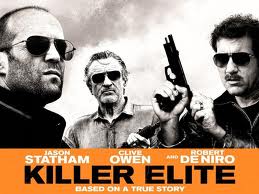
KILLER ELITE offers nothing new in the action department

   Before the plot gets rolling like a bolder down a steep hill, the audience indulges in a pre-screen title. The couple of sentences are related to covert operations and secret assassins. Show us. Don’t tell us. How do the filmmakers show us that the central characters are part of an elite society of killers? Is it because they’re dressed in slick black, carry heavy artillery, and have dynamite fighting skills? Perhaps so, but I need a better understanding of what a SAS (Special Air Service) man is supposed to really be like, than what I’ve seen in a plethora of action films related to international spies and terrorists.
            Killer Elite is the latest Hollywood action yarn to hit theaters. I found the plot to be too smart for its own good. The film is essentially about an oil sheik that kidnaps an SAS man, played by Robert De Niro, in order to force a retired assassin, played by Jason Statham (Transporter, Crank) to come out of hiding and do one last job. The sheik wants to avenge the people who killed his three sons, but, catch this; those very killers are part of the same SAS group. The setup sounds great; we get a game of cat-and-mouse between assassins part of the same group. Unfortunately, the execution is a cheerless and clichéd mess.
            Killer Elite opens with a dazzling action sequence; bullets spray across the frame and the car explosions create a pillow of smoke over the desert. When a film opens strong, it must continue along the rollercoaster, outdoing previous action pieces. After Jason Statham assassinates his target, he comes face-to-face with an innocent girl caught in the crossfire. The film cuts to a tight shot of her traumatized eyes and sets-up Statham’s motivation for retiring with his wife, a pointless character, in the Australian outback. Oh, and perhaps if you can’t understand why he wants “out” of this secret killing society, don’t worry, we see the same shot of those sad innocent eyes midway through the film. Get my point?
            So, as the plot continues, and the stone-like characters bore me, Statham receives a letter that his mentor, Robert De Niro, is being held prisoner. The next scene, he’s on a plane to the Middle East with the same old crew, doing the same old job, but this time around, is being chased by his own people. Clive Owen is also part of an elite group, and as his men are being killed one by one, he’s on a chase across the globe to take down Jason Statham. At first, I was confused as to who Clive Owen’s character really was. I’m guessing that the writers felt that if he’s dressed in black and talking in a so-called “serious” manner, in an undisclosed office building, then the audience will be able to guess that he’s part of the same SAS group. These visuals did not help. Instead, I had to really pay attention to the dialogue to figure this out.
            Apparently, Killer Elite is based on a true story. I suspect it’s based on true events, but the dangerous stunts and killing scenes were certainly embellished, which is fine in my book. I love action films. I love to be entertained by Hollywood stars and spectacular set-pieces, but if I didn’t care if these characters lived or died, I can’t immerse myself into the story. I understand that it’s an action piece, but if it’s a true story then there should be some social awareness about the greedy complications surrounding the oil industry.  All in all, Killer Elite bored me with international shenanigans.

* * (out of four stars)
Reply to:

Wednesday, September 21, 2011

THE DEER HUNTER remains a screen classic

            There’s a key scene in Michael Cimino’s Vietnam-era classic, The Deer Hunter (1978), in which Robert De Niro comes face-to-face with his prey; a beautiful, long-horned deer. He’s in perfect aim with his rifle, and in the backdrop are the breathtaking Pennsylvanian mountains. In a moment of psychological confusion and hurt, he shoots the rifle up to the sky. This single action surmises the entire film.
The opening setting consists of a small, working class town in Pennsylvania, built around a steel factory and a Russian Orthodox Cathedral. Working, drinking, bonding, marrying, and deer hunting are highly integrated into the blue-collar social structure. It’s a pure slice of sweet Americana.
            Robert De Niro’s character, Michael, takes pride in the recreation. Deer hunting is a tradition; a sacred bond between man and nature. Notice how Michael (De Niro) refuses to let his longtime friend, Stan (John Cazale) borrow his spare set of boots. He believes that if you’re a serious outdoorsman, then every item should be thoroughly accounted for. However, after bringing home the traumatic baggage of the Vietnam War, “killing,” even a deer, seems morally demeaning. The men’s values are warped after the horrific tour of duty. The Deer Hunter is essentially about the psychological affects the Vietnam War has on a true-blue, All-American, working-class society. The perspective of violence, warfare, service duty, and camaraderie are permanently askew in the bloody aftermath.
            The Deer Hunter is a sweeping epic told in three very distinct parts. 1. The grand wedding and farewell party. 2. The gritty war depiction. 3. Coming home and trying to build back an inkling of simple values, which were lost in the mayhem. What I love about The Deer Hunter is how unafraid it is to let every scene in the first part play out. It’s important to get to know and truly empathize with the characters.  The audience gets a better sense of how far they fell from their original personality, after Vietnam. In the end, we can’t help but care and hope for a better future.
In the first part, the director stages and frames a rich, panoramic wedding reception. In a series of magnificent wide shots, the frame is filled with townsfolk dancing, drinking, eating, fraternizing—it breaths of human connections. The director wants to make sure that you, the viewer, are allowed to inhale every detail of this all-American, tight-knit town. In another important shot, the camera pans and tilts around the Cathedral, emphasizing the Russian Orthodox heritage. In a more up-to-date film, I think the studios would find it necessary to point out the cultural overtones in the dialogue, or relay information using screen titles. Never underestimate your audience. Cinema of the 70s was very different. It was an artistic decade. Filmmakers didn’t need $150 million to create a grand epic, and the studios gave the directors more creative control.
            The Russian roulette scenes in Vietnam are by far the most suspenseful and provocative elements in the film. I found it interesting how the Vietcong would volunteer their own men and bet on a fatal game. I’ve never read or heard about underground games of Russian roulette as part of the war subculture. It could be meant as a historical fantasy—a thought-provoking way of metaphorically expressing the notorious “draft.” The chances of being randomly picked by Lotto Uncle Sam are no different than sliding a single bullet in a six barrel chamber, and praying it’s not going to be the last time. It reminds me of what Jack Nicholson said in the Departed (2006), “When you’re starring at a loaded gun, what’s the difference.”
            Watching a glorious 35 mm print of The Deer Hunter was almost as exhilarating as seeing Apocalypse Now: Redux. Francis Ford Coppola’s vision of war was more potent and imaginative; an almost, psychedelic experience. However, Michael Cimino’s The Deer Hunter is still a memorable classic; a truly emotional drama.

The 1978 Oscar-winner was showing exclusively at the Texas Theatre in Dallas. Make sure to checkout the movie theater’s website for upcoming screening.
www.thetexastheatre.com

Wednesday, September 14, 2011

Trash Cinema at the Texas Theatre

         Tuesday Night Trash is a laidback, film-geek venue, exclusively at the Texas Theatre in Dallas. The super-cool, tongue-and-cheek screenings puts the Midnight Movies back in the circuit. Sometimes, the theatre managers get lucky enough to snag a 16mm or 35mm print, but often, it’s a DVD projection. It really doesn’t matter. Catching these retro-schlock films on the big screen is a great pleasure.
            My first experience at Tuesday Night Trash was a screening of The Naked Kiss (1964). Personally, I wouldn’t lowball Samuel Fuller’s masterpiece as “trash,” but it’s definitely out-of-the-norm. After that first presentation, I was hooked. There are so many underbelly cult films I haven’t experienced, and the Texas Theatre has certainly enlightened my repertoire.
            Tuesday Night Trash generally consists of a hip, geek crowd, and some of the films are total cheese-cinema, but you know what, sometimes, you’ll find a diamond in the rough. The venue is about going out with your friends, laugh at the campy atrocities, and find a permanent social outing for Tuesday night.
            This week the Texas Theatre presented a 80s horror-bomb, The Basement (1989), which was a lost Super 8 film that finally got the chance to be somewhat re-mastered. The film is a horror-anthology; a zero-budget rip-off of George A. Romero’s Creepshow (1982). Four characters venture inside the basement of an abandoned house, and are encountered by a grim-reaper-like monster, who tells them about these horrific acts they’ll commit in the future. The four stories in The Basement are obviously influenced by famous indie-horror filmmakers of the 70s and 80s, which include George A. Romero (Dawn of the Dead, Day of the Dead)  Lucio Fulci (Zombie, The Beyond), and Sam Raimi (Evil Dead, Evil Dead 2).
           The majority of the Super 8 exposure is extremely dark; I felt as though I had to constantly scan from screen-left to screen-right to comprehend any of the action. In addition, the actors look like they belong in an 80’s porno, and the dubbing was so bad it’s almost funny. The director of The Basement pulls an Ed-Wood (the notorious, cross-dressing, sci-fi director of the 50s)—he uses found-footage of an erupting volcano to represent Hell on Earth.
            The point of these kinds of campy, backyard films isn’t to point-out the faults of the story, continuity, and lighting. I try to see how a filmmaker makes something out of nothing. For instance, I try to figure out what kinds of props, locations, and effects the filmmakers had at their disposal. In the case of The Basement, I presumed that they shot in a friend’s backyard for the pool-monster sequence, found locations where they didn’t have to get a permit, and got lucky enough to work with an inventive and humorous special make-up effects artist. Perhaps these inferences aren’t entirely accurate, but at least you can see what I gain from indulging in schlock-horror films from the 80s. Rounding out my point, these guys picked-up a Super 8 camera and said, “Let’s make a movie!” What did you do today?

Sunday, September 11, 2011

If you’re into gun-slinging and machete-wielding clowns, then come join THE LAST CIRCUS

           The Last Circus is part horror, part action, part comedy, and all around Spanish grindhouse-celluloid. This show deserves a round of applause for the bold imagination of filmmaker Alex de Iglesia. I don’t think I’ve had this much fun at the movies in a while.
The Last Circus is a mad, twisted tale full of gore, sex, and vengeful killer clowns.
      The film begins in Spain, circa 1937, when the citizens were persecuted by the Republican Army. That’s right—no more freedom, no more circuses, and no more clowning around. The director immerses the viewer into a spectacular and gorgeously shot war sequence in which the Republican Army ransacks a circus show. The look and grittiness of the battle scene is, in a technical sense, reminiscent of Spielberg’s Saving Private Ryan (1998). The frame rate of the gruesome, opening shots is split in half, and the images vibrate, as if the camera is attached to a moving power-drill.
            The central hero of The Last Circus, Javier, is an aspiring “sad clown,” continuing the circus-performing legacy in his family. Javier survives the persecution of Franco-ruled Spain in the 30s and 40s, and then moves into the early 70s, during the large, economic growth. The filmmakers create a terrific and mordant, opening credit sequence—a cheeky montage that holds-up to the super-cool, found-footage compilation in the beginning of Natural Born Killers (1994). The early images mix movie monsters with dictators and presidents; cleverly reflecting war persecution and social repression.
        When the film cuts to the present, 1973, the cinematography switches from a cold, smoky-bluish hue, to a vibrant and spritely New Spain. The look of the old world and the new world greatly contrast.  Unfortunately, the historical elements don’t weave very well into the outrageous story, but the point of the film isn’t to provide a realistic, history lesson for the viewer. Sensationalism is the filmmakers’ first priority and the history of Spain merely serves as the backdrop.
In the film we learn that the sad and pitifully jealous clown-hero never had a real childhood. As an adult, he’s emotionally tormented by his demented boss, Sergio (Antonio de la Torre), the lead clown of the circus, and his promiscuous, acrobatic lover, Natalia (Carolina Bang). Consequently, Javier feels obliged to protect the circus whore, and ends-up being beaten to a bloody pulp by his meal ticket, Sergio. The hero of the film is first portrayed as a confused, psychologically scarred, shy clown and then gradually develops into an angry-rollicking-killing machine. In the final act of the film, Javier takes a mad turn for the worse. His clown makeup is comprised of burning a layer of skin off his face with sodium chloride and placing a hot iron against his cheeks. To add to the shocking, comedic elements, the director giddily applies CGI (Computer Graphics Imagery) to some of the exaggerated and action-packed images.
The filmmakers aren’t trying for realism; the special effects and art direction are justly over-the-top. The tongue-and-cheek visual style nicely matches the overtone of the out-of-control plot-line. The Last Circus is definitely all over the place, weirdly mixing humor, gruesomeness, kinky sex, and a rain-storm of bullets, but it’s a show that’s hard to shake off. The Last Circus ran its final show Thursday night at the Texas Theatre in Dallas. However, it will be available on DVD and Blue-Ray in October; don’t forget to check this bad boy out.
*** (out of four stars)

Woody Allen's MIDNIGHT IN PARIS is a sincere pleasure

Midnight in Paris comes off as a sweet love letter to one of Woody Allen’s favorite cities (it doesn’t compete with his portrait of New York). I could imagine his neurotic, creative process. He probably took a quiet stroll along the Parisian street, went into his apartment, hopped in the shower (his thinking sanctuary), and then bam—the idea came to him in a wet flash.
            “Well, ya know, ya, I think, ya, wouldn’t it be a spontaneous, creative move, if-ya-know, I was somehow magically transported into the 1920s and hung out with all of the great literary and artistic heroes of our time in the cultural arts center of the world?”
            Midnight in Paris isn’t Allen’s best film to date, but it’s still an endearing and dreamy venture.  His signature is written all over it. He’s one of the few filmmakers, who both writes and directs all of his work, and it’s very distinctive; no one can make a Woody Allen picture besides the prolific director himself. I’m quite enamored by Allen’s simple, yet beautiful vision of every shooting location—New York, Paris, or London—I feel as though I walked into a classical Hollywood musical set. The camera is usually static and the music is mellow, but there’s a grace to all of his images.
            The film is about a Hollywood screenwriter, Gil (Owen Wilson), who vacations in Paris with his fiancé, Inez, (Rachel McAdams) and her family, hoping to find inspiration for his new novel. During one of Gil’s walks, an old car pulls up and he’s swept away to a party where he’s conversing with Picasso, Cole Porter, F. Scott and Zelda Fitzgerald, and Ernest Hemingway. He’s captivated by the nostalgia of the city’s romantic flavor; this unusual fervor clashes with his fiancée, Inez, who prefers to buy over-priced furniture and go dancing, while Gil prefers to take a refreshing stroll at midnight. The book he’s writing is about a man who owns an old, memorabilia shop, full of sentimental history. The scenario in Gil’s story sets-up the exposition for the character’s time-warp into old Paris.
When Gil and his soon-to-be-family are dining at a café, Inez runs into an acquainted couple. This happens a lot in Woody Allen’s films. Friends will run into old friends and new sparks will fly.  When the couples double-date, they passive-aggressively compete with one another—whether it be beauty, intellect, or sex. My favorite competing couple was in Allen’s black-and-white masterpiece, Manhattan (1979), but his latest film, Midnight in Paris, is still a joy to watch. The film contains the classic overlapping dialogue, dining settings, and typical-Woody-neurosis.
The way Woody Allen shoots says a lot about his personality. For example, he prefers to shoot on a cloudy day because it’s easier to control the lighting, and it gives the images a pastel-hue. In addition, he prefers to keep the camera rolling, inertly panning back and forth, which draws more attention to the performances than the camera work.
Most importantly, he shoots at a rapid pace. Woody Allen likes to be done by 6:00 pm, so he can rush to dinner at a reasonable hour. Midnight in Paris was selected as the opener at the Cannes Film Festival. I’m sure the French greatly appreciated this gesture.
*** (out of four stars).

Thursday, September 8, 2011

THE GUARD doesn't quite top the indie-crime wave

   The Guard is a hip, low-key, black comedy about two officials, one a local Irish policeman and the other an American FBI agent, who join forces to uncover a large, drug-trafficking operation. The central figure of The Guard is a zany and abhorrent Irish Sergeant, and seems like a character especially tailored for the comic likes of the late Peter Sellers or even Bill Murray. However, I must say, Irish indie-fave, Brendan Gleeson, shines in The Guard; his irreverent behavior is the perfect match for the straight-laced FBI Man, played by Don Cheadle. It’s too bad that I’ve seen this kind of oddball, criminal scenarios in a number of dark comedies, specifically the awesome In Bruges (2008), which was written and directed by Martin Mcdonagh, brother of the director of The Guard, John Michael McDonagh.
            
   The Guard opens strong, but as the clichéd, criminal plot treads along, the energy loses steam. The film opens with the bumbling Sergeant observing a drunk-driving accident along the road. A group of partying teenagers flipped their car and everyone was killed. Instead of taking the drastic situation seriously, Gleeson frisks one of the victims for any “goodies.” The Sergeant recovers a bag of drugs; he disposes of the cocaine and pops a hit of acid in his mouth. The filmmaker inserts an extreme-close-up shot of the smiley-face-acid blot. First-time director, John Michael McDonagh, perfectly establishes the bizarre and dead-pan, humorous tone, but all it really did was cause a craving for more outrageousness.
    The quirky and dim-witted police investigation holds many similarities to Fargo (1996), but unlike the Cohen Brother’s black comedic masterpiece, The Guard’s portrayal of mass corruption and murder in a simple town, doesn’t measure, not even close. I felt as though this sort of criminal-caper comedy came out a decade-and-a-half too late. It would’ve been a bigger hit in the mid-to-late 90s, especially after the post-Pulp Fiction (1994) phase.
    Besides Fargo and In Bruges, I’ve seen this sort of film before—take a look at Guy Ritchie’s English gangster hits, Lock, Stock, and Two Smoking Barrels (1998) or Snatch (2000). These were all indie gems where the criminals and the cops talked about everything humorous to them, except the plot. As you know, director Guy Ritchie and many other filmmakers in the 90s, were incredibly inspired by the ingenious hybrid of comedy and gruesomeness that was well-established in Tarantino’s Pulp Fiction. The criminals and the bumbling detectives would bicker back and forth and the audience is supposed to laugh, where I merely smirked.
    On a lighter note, I absolutely loved the rural setting—I think the filmmaker mixes different 35mm film stocks, enhancing the beauty and variety of the small Irish backdrop.  I was taken by the charming surroundings—the small local pubs, lushly green hills, and the rocky cliffs clashing against the cool blue sea. After seeing this film and the light-hearted Waking Ned Divine (1998), I’m going to have to make it a plan to visit a small Irish town, where I’d be the only American that stands out. If you closely observe the background, you’ll notice there are only a small handful of characters living in the community; my favorite being an odd English boy who drags his dog along his small pink bicycle. The filmic images in The Guard have a child-like, picture-book quality to the texture-a variation of bright and dim cinematography-and I loved looking at it.
    I think The Guard is worth checking out, perhaps when it comes out on DVD. While you’re at it, follow the film with In Bruges and Lock, Stock, and Two Smoking Barrels. Then, you’ll notice the great, humorous whims of all three films, along with the clichéd similarities of the foul-mouthed characters.
 **1/2 (out of four stars)
            

Friday, July 1, 2011

TREE OF LIFE is a cinematic, breath of fresh air

      Auteur director, Terrance Malick, certainly lives up to his reputation as a masterful artist; painting bold and picturesque images, rich in metaphors and thought-provoking in context. What starts out as a genuine observation of a traditional family in the 1950s and early 60s, develops into a spiritual and philosophical understanding of life, and what it means to appreciate life in all of its marvels. These underlying themes and messages are not spelled out onto the screen, but if you’re familiar with Malick’s work,  than you can see how his artsy, image conception leaves the viewer plenty of room to make their own interpretation.
            My first impression of Tree of Life concerns the director’s awareness and appreciation for human growth and development; a spiritual connection with our environment. An innocent boy from a small Texas town grows up to be a man, he then finds his niche in a bustling, modern society, and without any dialogue or a detailed explanation,  the film subtlety expresses a man’s loss of appreciation for life’s organic surroundings. I always thought that Malick's work was primarily about how the industrial revolution tainted our natural landscape, and disturbed a once, peaceful society. Both Badlands (1973) and Days of Heaven (1978) are terrific examples of the filmmaker’s dichotomy between a rural and an industrialized society, and how each environment directly affects civilization.
             The characters in Malick’s films include lovers on the run in Badlands, the farming community in Days of Heaven, and the WW II combat soldiers in the Thin Red Line (1998). However,  “nature” is the most important character in all of his work. Malick and his film crew want the audience to really look and appreciate gods gift to man; rows of giant sunflowers erected high above the soil, waves crashing and rolling above the ocean floor, oak trees towering the sky, and the summer breeze mildly blowing against the weeds.
            Tree of Life spontaneously cuts between the past and the future, and for the most daring and awe-struck sequence, Earth’s beginning of time. The calendar-like images evoke a sense of childhood innocence. Malick looks through the camera as if he’s imagining a child seeing the ocean for the very first time. He embodies a childlike perception; always looking up at the trees, gazing at the other neighborhood families, twirling around the house, and gliding close to the ground.
            The main character is an angry adolescent boy, taking the responsibility of the oldest son. I loved how the film cuts to the boy’s face—there are jarring jump cuts of his pondering expressions. However, the camera isn’t just showing the boy’s face, it captures an adolescent’s implosive emotions, shifting from carefree to frustrated and lost. His father, played by Brad Pitt, plays an earnest and tough-as-nails man, but a great provider for his family. The boy and his father are distant in emotions, yet ironically, we sense the boy turning out to be just like his father. Some might view Brad Pitt’s character as harsh and insensitive. I like to think otherwise. I believe that Brad Pitt is portraying a realistic and common father figure; a fair depiction of the norm of parenting during that generation.
             The film unexpectedly cuts back and forth in time, from the boy to the grown man, played with a quiet sensibility by Sean Penn. The audience can sense his longing for the old suburban landscape he grew up in. He’s lost in a world of tall skyscrapers, nonstop traffic, and business suites. The way Malick captures a modern society is thoughtfully juxtaposed with the pleasant imagery of the 1950s era.
            Tree of Life isn’t a plot-driven drama. The wild juxtaposition of natural images, childhood memories, minimal dialogue, and spontaneous jumps in time seems like the overall narrative is disjointed, but at a closer look, you’ll find that Tree of Life is surprisingly well-structured. There are bold, imaginative sequences that seem like they are part of a completely different movie. Similar to Fellini’s 8 ½ (1963), Tree of Life is a cinematic exploration. I felt as if midway through filming, the director decided to take certain ideas concerning life, death, and the heavens above, and propel his keen, visual aesthetics into uncharted territories.
This is a down-to-earth film with sincere observations and nature-like cinematography, yet there are fantastical scenes that make great use of CGI (Computer Generated Imagery) and sound editing, which shows that Terrance Malick stands next to the great wizards of Hollywood, which include, firstly, Stanley Kubrick, (2001: A Sapce Odyssey) then Steven Spielberg (Close Encounter of the Third Kind), and more recent, Peter Jackson (Lord of the Rings).  Tree of Life contains spectacular and jaw-dropping visuals that compete with the skills of Hollywood's powerhouse players, yet it’s epic in a much different way; a wholly and groundbreaking piece of cinema. It’s the antidote to formulaic, Hollywood blockbusters.
**** (out of four stars)

Friday, May 20, 2011

"Forget it Jake...it's CHINATOWN"

        When I first saw Chinatown (1974) at age 12, I couldn’t grasp the “water” scandal in the story. Sometimes, I need a visualization to fully comprehend a scientific and economic scenario. I like that about Robert Towne’s breakdown of the birth of Los Angeles in 1930s LA, and how the irrigation controlled the future of the city. The film doesn’t spell out every scandal, but instead, leaves the audience more room to think, analyze, and compare the screenplay’s monumental themes of power and corruption. After each viewing, the inner-workings of the water scandal become more clear, and I usually discover a new detail in the frame, which I overlooked in previous viewings.
        With that said, Chinatown is one of most intelligent scripts ever written. The initial conflict between an alleged affair between a high-profile engineer of the city's water supply and a mistress escalates to a fraudulent scandal, but by the end, the most important revelation deals with the characters dynamics, not water.

        Now, as far as my first screening of Chinatown goes, I was blown away by the final scene. Everything comes together perfectly, and even though the story stops at the street, we know what happens to every main character, beyond what was written. Screenwriter Towne and director Polanski present these intriguing characters—everyone is hiding something, everyone has a secret, and everyone is alone. The events that follow in the final seconds of the film spills the central characters true colors; we finally see the corruption come to light. We hear about the corruption running rampant in the city as we follow Jack Nicholson’s investigation, but at the end, corruption, profound and stomach-churning corruption, is finally exposed on-screen.
        This is just as much Polanski’s film as it is Robert Towne’s script. In fact, I have read several books, which detail the conflict between the two artists. The finale contains a sudden death, which reflects Polanski’s own grieving incident; the shocking murder of his pregnant wife, Sharon Tate, in 1969.
        Chinatown is Jack Nicholson’s finest performance, next to Five Easy Pieces (1970). Robert Towne wrote the script with Nicholson in mind, and the sarcastic and biting dialogue couldn’t have fit a better actor. When Jake Gittes (Nicholson) starts his investigation, the camera sticks to his perspective. In one scene, Nicholson is spying on his latest lead, Hollice Mulwray, but when Hollice turns the corner, leaving Gittes sight, the camera stays with Nicholson, quietly building his intrigue. Another great shot is when Nicholson is spying on Mulwray, while blending in a rowboat pond, and as he adjust his camera, Polanski’s film camera moves back and zooms forward, underscoring Nicholson’s point-of-view. However, Polanski never wants the camera to cut to Nicholson’s actual eyes. Nicholson is always in the frame—we see him snoop around, discover details, ask questions, and solve a puzzling mystery, piece-by-piece.

Polanski and Nicholson duke it out on set
        Roman Polanski has an excellent photographic eye. He’s great at creating a distance between the characters and their external environment. Observe how far Nicholson is from the people he’s spying on, and as relentless as his character is, he’s seemingly cautious when he snoops around. The opening shot shows one of Gittes clients perusing sexual pictures of his wife and another man. The first scene is an extreme-close-up of these invasive photographs. It says that Gittes isn’t intrigued by the work he’s done--he knows what the pictures are of, even if they are seen by his client’s point-of-view. However, when Gittes makes his most important discovery, a small pair of broken glasses, the camera remains over his shoulder. It’s not necessarily what he discovers that’s really important, but actually witnessing Nicholson discover an important element in the case.
        Chinatown is classified as a modern-day noir. The film contains similar themes, moods, and characters as in a black-and-white noir from the 1940s, but visually and aurally, the film is Polanski’s original creation. Like many film noirs before Chinatown, the protagonist is alone—his work is his life, there are no kids, no family, no lover; just the urge to solve a mystery. Existentialism—feeling alone, surrounded by corruption, is evident in Chinatown.
        In addition, the 1930s décor and costumes, violence, and disturbing sexual content exude an all-around “noir” feel. The sunny and golden look of the atmosphere might reek of an optimistic setting, but the underlying content in Chinatown, makes Double Indemnity (1941) feel fairly tamed.
.        Chinatown contains one memorable scene after another. When Jack Nicholson slaps Faye Dunaway (Evelyn Mulwray) numerous times across the face, the abrupt violence against an unarmed woman seems bizarrely justified. Throughout the film, Jake Gittes has been deceived, scammed, setup, and framed by a myriad of characters. He’s tried manipulating and snooping, but the truth will spill-out in front of him, one way or another. He wants the truth, and if smacking around his love interest will get that, that’s just what Gittes will do.
        Chinatown is the greatest private-eye noir that I’ve ever seen. It’s a mystery, wrapped in a mystery, wrapped around an even bigger, character-driven mystery. Like an onion, layers of controversy are steadily revealed, until the audience realizes that the most profound revelation has little to do with an unsolved murder or the water supply, but more importantly, the inherent evil, which hides behind a seemingly, respectable society. Pay careful attention to the narrative and how the story is structured, and you’ll realize Robert Towne’s overview of his powerful script, “Chinatown isn’t about a place. It’s about a state of mind.”

Tuesday, May 10, 2011

SUPER is one crude piece of indie-filmmaking

The rebellious content behind Super is so down-‘n’-dirty, you’d think it was conceived while the writer/director was on the toilet. James Gunn’s second feature film attracts an A-list cast. Wouldn't you be slightly curious as to why a little, grotesque fantasy like Super would attract the agents of some of Hollywood’s beloved movie stars, such as Kevin Bacon, Liv Tyler, Ellen Page, and Rainn Wilson?
Filmmaker James Gunn has been labeled as an “auteur” (I forgot where I read that). Not quite, but there is a distinct flavor to both Slither and Super; they both are over-the-top in the gore department and still, laugh-out-loud hilarious.  For my money, Slither is a more clever, low-budget, cult experience, compared to Super, but all in all, both are naughty dark comedies, worthy of repeated viewings.
 Writer/director James Gunn creates an anti-super hero, who’s a bit off-putting, but Rainn Wilson is very likable, and his portrayal as Frank is very dry and funny. His intentions aren’t necessarily to fight crime, but to rescue his wife, played by Liv Tyler, from falling into a downward spiral in the hands of Kevin Bacon’s character; a flashy and slick heroin dealer.  Frank is a character who doesn’t know much about super heroes. He gets his ideas from a Christian channel, which airs a cheaply tailored and offensive, daytime super-hero sitcom, and his crimson costume, full of awkward straps and buttons, mimics the show’s grungy, home-made concoctions.
 Frank comes across a 20-something girl, who’s a well-informed comic book geek, played with a manic fervor by the extremely talented, Ellen Page (Juno and Inception). At this point of the film, I couldn’t hold-back my laughter. Ellen Page’s character is the largest walking contradiction I’ve seen at the movies in a long time. She comes off as so sweet, cool, and charming, but the reality of her character is absolutely insane. You can tell that Ellen Page and the rest of the cast are having a blast transforming their parts to cater to James Gunn’s vile imagination. However, despite a series of dark, gruesome, and funny sequences, all of the characters lack a humanistic dimension. The concept itself has more depth than the individual characters. I think Liv Tyler has the most realistic portrayal; she’s truly the only individual who changes after confronting the lowest possible scenario imaginable for a dope whore. The rest of the characters are more into their groovy dialogue and shocking behaviors, rather than tapping into a realistic, psychological dynamic. 
 I wouldn't be surprised if James Gunn was thinking of Taxi Driver (1976) when he wrote the hero. Similar to Scorsese’s beloved masterpiece, Super is sort of about celebrating bloodied violence, and taking a mentally disturb nut-ball and commending his murderous impulse. This was certainly true for Robert DeNiro’s captivating and surreal perspective of a genuine madman, but I think there’s very little psychological depth en route for a provocative discussion, especially concerning the crimson crusader in Super. Despite some of the film’s goofiness, which unfortunately softens the edge, Super is a balls-to-the-walls, take-no-punches, exercise in crudeness, and I was very curious as to which direction the film would take after the abrupt shifts of random gore and cheap orgasms.
           
*** (out of four stars)

Thursday, April 14, 2011

THE NAKED KISS (1964) is the coolest, underground classic

I’m nineteen, and I walk into Starlight Video. The year is 2003, tape stores were still around. I browse the aisles. I peruse the various sections, which include “new releases” “blaxploitation,” “ Hitchcock,” “Italian Cinema,” ect.. I yell at Peter, the owner, “Hey, what should I get this time? There are so many!” Next, I picked up a DVD that attracted my eye.
“What’s The Naked Kiss?” I asked.
“Oh it’s a classic, Yale. You must see it." 
After watching The Naked Kiss (1964) for the first time, I was blown away. I thought to myself, “Now, this is cool cinema.”
 The story is about a prostitute who escapes her corrupted lifestyle, moves into a charming little town and becomes the beloved nurse of crippled children. Ironically, she ends up stepping into the same kind of underbelly she was escaping from, but this time around, the disturbing elements were part of a respectable society. The Naked Kiss is my favorite Samuel Fuller film; an awkward stroke in low-budget filmmaking. The film contains the most unusual melding of noir and melodrama.
            At the time this low-budget gem was released, it was incorrectly labeled as a “sexploitation” film. This was in 1964. According to today’s standards, Samuel Fuller’s strange melodrama is a biting commentary on social hypocrisies. Fuller lures the audience into a world of prostitutes, pimps, and a strip-club/bordello that uses a respectable business as a cover-up. Before “hooter” girls were born, there was chocolate-selling “bon-bon” strippers. In addition, writer/director Fuller suggests psychological concepts, such as mental illness and sexual abuse.
            Fuller’s style and sociological commentary are very in-your-face. The opening shot is so rough and edgy that it almost throws you off balance. We see a raging woman batting her purse at the camera. A drunken man, her pimp, grabs her hair and rips off a wig. Now, we see a bald-headed femme fatale kicking the crap out of a man. The first few images, combined with the chaotic jazz music, is so raw and gritty, you must think the rest of The Naked Kiss is going to be a totally dark film noir. Dark; yes, but after the opening scene, the credits roll, and the star, Constance Towers, puts her wig on and elegantly fixes her image in front of the mirror. Simultaneously, the music shifts into something out of a Doris Day's melodrama. This is the joy of watching the film; the abrupt shift from film noir to a full-fledged, glowing melodrama. There are parts where the film is a bit choppy, but that’s part of its low-budget charm. Some of the dialogue is a bit soap-opera-ish and unconsciously comical, but still, it’s purely fun and provocative at the same time. A forgotten or hard-to-find film like The Naked Kiss has more qualitative direction and a cooler style than a lot of today’s big-budget studio films.
            For those readers who’ve seen the film, don’t you think there should be some-kind of monumental screening? Like at the Cannes film festival (maybe there was)? A masterful director like Martin Scorsese should present it. I mean, watching it again, I see so much daring and unusual camerawork and editing, which I’m sure have influenced up-and-coming directors of the late 60s and 70s. For example, Bonnie and Clyde (1967) was known for its distinctive opening shot; actress Faye Dunaway’s face is clinging onto the bar rails of her bed, which expresses her personal imprisonment. However, before 1967, Sam Fuller constructed an even more abrupt, daring, and original opening. Most mainstream American films in the early 60s were still utilizing a classical style; they opened by establishing location, not energy.
I also think Fuller’s work influenced filmmaker Quentin Tarantino. Sure, the sudden outburst of violence is there, but I’m thinking of a smaller reference. In a scene from The Naked Kiss where Kelly gets off the bus in the quaint town, the first iconic image is an old-style movie theater, and the marquee reads “Shock Corridor,” which was Fuller’s previous film with the same small studio. The parallel influence I’m referring to is in Tarantino’s Kill Bill (2003), where we see a giant ad for “Apple” brand cigarettes in the background, as “The bride” (Uma Thurman), enters the airport. The reference to Fuller’s previous and similar film, Shock Corridor (1963), is a bit obvious, but I like those catchy, inside-joke film references. Also, I get a real geeky kick when I see directors linking their films together by the minor mis-en-scene.
            The juxtaposition of soft and hard images in The Naked Kiss divides the film’s tone, shifting from the classical to the avant-garde. There’s a unique scene where our hooker with the heart of gold is falling in love with the town hero; a rich, giving and accomplished playboy. Then, the man shows Kelly a home-made film reel of the river flowing through Venice. Suddenly, the two lovers are imaginatively transported into the image. The stylized use of rear-screen projection is very stagy, but that’s part of Fuller’s inventive idiosyncrasies. Another great scene is where the film moves into an effective musical sequence; Kelly sings “the blue bird of happiness” with a group of racially diverse, crippled children. Again, Fuller pushes the boundaries by purposely using a variety of races in the children’s portrayals, yet all, or most of the adult townsfolk, are white. The musical scene is a combustible stir-pot of sweet, dreamlike and creepy tones, and it sets-up the disturbing revelation.
The plot might seem too over-the-top, creating too many drastic shifts in character relationships and revelations in a swiftly running time of 90 minutes. Nevertheless, Fuller stays true to his usual cinematic obscurities, while developing a richly textured story. We follow Kelly, who rapidly transform from the low-brow whore with the fiercest stilettos you ever did see, to a gentle town nurse for handicapped children. I get so giddy watching the shifty character interactions and campy dialogue. I wanted the frame to stand still and let every scene play out with more dialogue and more attitudes; it’s one hell of a fun time.
            Constance Towers was great to gawk at on the big screen. Her strong cheek bones, thin frame, and threatening eyes make it impossible to turn away. I wish I could’ve seen her act in a Hitchcock film (Vertigo, Rear Window). She totally could’ve been a part of Hitchock’s star-power blondes, which included Grace Kelly and Kim Novak. Constance Towers had just as much glamor and energy behind her image as any of Hitchock's historical and brilliant bombshell beauties. The entire film is built around Kelly’s transformation, but her bad-old ways bring many life-lessons to the supporting characters. Still though, her gracefulness shines.
 The last, and the most distinguished directorial vision, is the filmmaker’s blunt messages, which are still taboo for 1964. The best sequence is the actual “naked kiss.” The direction, the extreme shot/reverse shots, and the lack of music (only the ambient sound of a powered film reel) all build suspense, and sets up the most important plot-point of the film. The naked kiss, if you haven’t figured it out, is………. oh no, I don’t think I could live with myself if I gave out that piece of information.
I had the great opportunity of witnessing the cult classic on the big screen at the Texas Theater in Dallas, TX. Yes, that’s the same theater where Lee Harvey Oswald hid-out after shooting a cop (so they say). The Pick Up on South Street (1953), Another film by Samuel Fuller, is great and a more polished, thriller-type film, but The Naked Kiss remains my favorite, the perfect underground classic. This is one of my favorite films of the 60s and pushed me to experience all of Samuel Fuller’s work.

**** (out of four stars)
Tuesday, April 12, 2011

BEAUTIFUL BOY contains heartbreaking performances (Part of Dallas International Film Festival)

            When your only son commits a heinous school shooting, how do you cope with that kind of shock? How can the parents of the victim and killer move on with their lives? Beautiful Boy presents an emotionally painful and controversial situation as the backdrop; however, the real drama concerns a sad marriage, falling apart, bit-by-bit.
            The grief-stricken and emotionally stunned married couple is brilliantly portrayed by Michael Sheen (Frost/Nixon) and Maria Bello (The Cooler). Beautiful Boy is mainly a performance piece. It’s exciting watching two great actors build two implosive performances and take my word; they shine all the way through.
            The film was shot on Super 16mm and the camera is handheld; the combination of a jagged style, shaky close-up shots, and a smaller camera gives the film a docudrama-like feel. The deteriorating marriage reminded me of Aaron Eckhart and Nicole Kidman in the recent, Rabbit Hole (2010) (another grief themed movie), Michelle Williams and Ryan Gosling in Blue Valentine (2010), and Tom Wilkinson and Sissy Spacek in the depressing, yet brilliant, In the Bedroom (2001).
            Even though Beautiful Boy has a very thought-provoking premise, relevant to several real-life incidences, I still felt that the anguished couple from In the Bedroom was a more dramatic depiction. Beautiful Boy observes the grief, but I liked the dynamic shift from heartache to cold-blooded revenge in In the Bedroom.
            Ever since the shocking Columbine incident, several films have explored the devastating aftermath. These films include Michael Moore’s political, expose documentary, Bowling for Columbine (2002) and Gus Van Sant’s experimental mood piece, Elephant (2003). Personally, I think Elephant was the most provocative and technically inventive, using the senseless high school shooting to reflect on a variety of social issues. However, Beautiful Boy presents a provoking dilemma; how do you grieve for a loved one who’s represented as a mass murderer by the media?
            Despite the realistic and woeful character observations, I wish the filmmakers used the pestering media to comment on the demeaning exploitation of the family’s situation. Sure, the film touches on the subject matter, concerning the media’s pressure, but I wanted the subtext to emerge, rather than sit in the background.
            I’ve seen grieving couples in a plethora of dramas, and as absorbing as Beautiful Boy is, I felt it could’ve expressed a stronger sociological awareness. Still, Michael Sheen and Maria Bello are at the top of their game, and as far as Sheen’s performance goes, this film will establish him as a more versatile actor.

*** (out of four stars)

THE INTERRUPTERS are taking action (part of Dallas International Film Festival)

            The Interrupters is a stimulating, yet lengthy documentary, commenting on urban violence. The filmmakers are taking matters in their own hands, exploring the senseless violence in the urban parts of Chicago. The “Violence Interrupters” is a non-profit organization, a group of concerned citizens, who are trying to halt the savage murders in their community. The purpose of the group is to let the young urban community know that they have a choice to avoid prison, gangs, drugs, and death.
            The documentary follows several individuals whose lives are gravely affected by the gritty streets. The filmmakers stay behind the scenes; a fly-on-the-wall approach to documentary filmmaking. The objective is to study the positive transformation of these young subjects. During the course of the film, we see these real people endure correctional facilities, friends’ funerals, and injuries due to sudden street outbursts.
            We see smart and capable people doing stupid things, and before you know it, they’re six feet under or spending life in prison. Then, "The Violence Interrupters” step in, persuading these young adults to turn their lives around. My personal philosophy; everyone deserves a second chance. No one is really trapped in a bad situation. Sometimes, people need the right hand to pull them out.
            The Interrupters has the potential to be like the epic documentary, Hoop Dreams (1994), which follow several students as they survive the pitfalls and ultimately, achieve their goals. However, at 2 hrs and 47 minutes, I felt The Interrupters should’ve been trimmed down. I don’t think a chronology of 14 months, and one subject matter constitutes a mere 3 hr documentary film.
            A lot of the deaths we hear about in the film involve gun use. My personal interpretation has less to do with violence and more specifically, “shooting” violence; the power a person feels when they’re holding a gun. There’s a scene where one of the subjects wanted to seek revenge, and he talks about grabbing his “pistol.” STOP—this is the point where a new topic should’ve been introduced; the scary glamour of possessing a gun. However, interweaving a new topic in documentary filmmaking can cause an abrupt shift in focus. Overall, the filmmakers present an important issue, which reflects our urban violence, not just in Chicago, but all over the nation.

*** (out of four stars)